
Design and Innovation in Banknotes and ID Recognised at HSP Latin America 2026
The Regional Banknote and ID Document of the Year Awards form part of the industry’s High Security Printing (HSP) Latin America conference. This year’s event was held in Guatemala City, Guatemala, with the awards presented at a special ceremony during the conference dinner on 2 June.
Awards were made in the following categories for the Banknote awards – Best New Banknote, Best New Commemorative Banknote, Best House Note, and Best Environmental Project – with Paraguay, Guatemala, Canadian Banknote Company, and Blendpaper all receiving recognition.
Meanwhile the new category of Best New Process or Technology (Currency) was won by G+D Louisenthal.
This year’s ID Document Awards recognised outstanding projects in several categories – Best New Series, Best New Digital ID Programme, Best New Passport, Best New Process or Technology (ID), and Best New House ID Card – with the Dominican Republic, Costa Rica, Argentina, Aruba, IN Groupe, and Authentix all receiving recognition.
BANKNOTE AWARDS
Best New Banknote
The Central Bank of Paraguay received the Best New Banknote award for its upgraded version of the 100,000 guaraní note featuring Oberthur Fiduciaire’s new security thread, Relief™.

Relief™ creates an optical illusion that heightens the observer’s visual perception like a trompe l’oeil (‘to deceive the eye’) – a technique that creates a highly realistic 3D optical illusion on a flat surface. The pattern created by the Relief feature has been utilised in the security thread, with the 3D effect obtained without mechanically embossing the micro-structure, making the visual effect highly durable.
The designs of the note remain the same, with Saint Roque González de Santa Cruz depicted on the obverse, complete with a stylised halo. Santa Cruz was a Jesuit priest who was the first missionary among the Guaraní people in Paraguay. In the centre of the note, to the left of Santa Cruz, features imagery of Paraguay’s national coat of arms – with the obverse of the coat of arms on the left and the reverse on the right. In the centre of these two emblems is the main image depicted within the latter, a golden lion sat in front of a staff and Phrygian cap, printed on both sides of the note in perfect registration.
The reverse design features Itaipu Dam on the left, a hydroelectric dam situated on the Paraná River on the border between Brazil and Paraguay. A stylised Ñandutí (‘spider web’ in the Guaraní language) design, reminiscent of the traditional Paraguayan lace made with fine needlework, is depicted to the right of the dam.
The 100,000 paper note also features intaglio, microtext created using offset and intaglio printing, security fibres and numbering activated under UV light, perfection registration for the national symbol, as well as a watermark.
Read more ▼
Best New Commemorative Banknote
The Best New Commemorative Banknote award was presented to the Bank of Guatemala for its new commemorative 100 quetzales banknote, issued to celebrate the 80th anniversary of the central bank’s foundation.
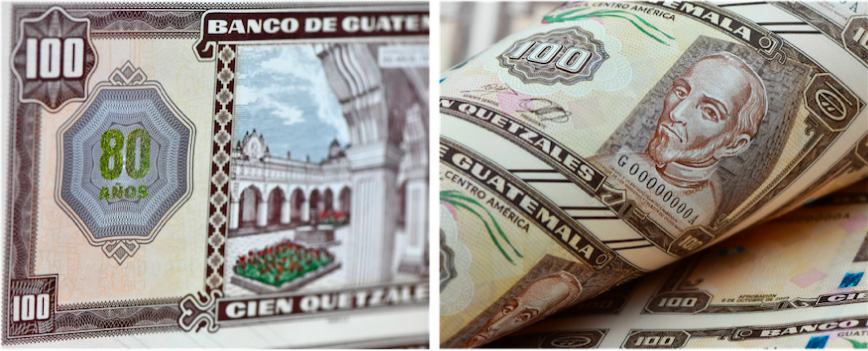
The design of the new commemorative note is closely linked to that of the banknote currently in circulation, but also incorporates motifs and aesthetics from the 1960 edition of the note.
The obverse depicts a portrait of Bishop Francisco Marroquin, a defender of the native people and instrumental in the progress of education in Guatemala. It also shows an image of Guatemala’s national bird, the quetzal (after which the currency is named), inspired by the first banknote issued by the Bank. The Bank’s building is depicted behind the portrait of Francisco Marroquin.
The reverse design features an image of San Carlos University in Antigua Guatemala, which celebrates its 350th anniversary this year. Another new design feature of the commemorative is the incorporation of details inspired by one of the murals in the Bank of Guatemala building, recognising the iconic art and architecture of the Civic Center, declared a National Cultural Heritage site.
A KINEGRAM COLORS® security thread with VIVID and FLUX effects is visible on the front of the note, with three windows and the number ‘100’ in Arabic and Mayan characters, and ‘EL QUETZAL ES ORGULLO, CONFIANZA Y FUTURO PARA GUATEMALA’ in microtext, which translates to ‘THE QUETZAL IS PRIDE, CONFIDENCE AND FUTURE FOR GUATEMALA’.
The banknote was printed by Polish Security Printing Works (PWPW), with a print run of 15 million. It was presented by the Bank of Guatemala during the High Security Printing Latin America conference itself.
Read more ▼
Best House Note
The Canadian Banknote Company (CBN) received the Best New House Note award for its Grizzly Bear banknote, which draws inspiration from one of Canada’s most dynamic natural events: the sockeye salmon run along the Adams River in British Columbia.

Rather than relying on symbolic or institutional imagery, the design focuses on Canada’s remarkable biodiversity and the interconnected ecosystem that supports the salmon’s journey. The use of natural tones drawn from the river environment gives the note a visual authenticity connected to Canada’s landscape.
At the centre of the design is a grizzly bear, engraved with some of the most intricate line work ever produced at CBN. On the reverse, the osprey and elk continue the environmental story, depicting the wildlife sustained by the salmon run.
A subtle but striking effect emerges when two notes are placed side by side: the transparent window areas visually connect to form the impression of a continuous pool of river water, reinforcing the theme of movement and connection.
The illustrations not only tell a story, but they also integrate advanced security features throughout the note. CBN’s engraving, intaglio, and front‑to‑back register work to form the foundation of the note’s security architecture.
Integrated within this structure are select micro‑optical security features included through CBN’s collaboration with CCL Secure, on whose GUARDIAN™ substate the note is printed. Their CINEMA™ technology, embedded directly into the substrate, introduces subtle motion and depth that enhances the river narrative.
Complementary features, including IRISWITCH™ effects in the water, Spot Colour, Shadow Image, and Half Window, work together to create a cohesive, multi-layered security design. These elements are intended to support the artwork rather than compete with it, demonstrating how thoughtful design and advanced security can elevate each other.
Read more ▼
Best New Process or Technology (Currency)
The Best New Process or Technology (Currency) award was presented to G+D Louisenthal for its TwinColors® Patch, a revolutionary micromirror technology that doubles the security impact of the whole patch – the inner design motif (image, number or letter as a motif flip) and, independently, the outer dynamic effect.

TwinColors® is based on a two-layer micromirror architecture, with each layer implemented in a different colour. The first layer is equipped with a highly complex shutter or louvre effect and enhanced with special functional coatings. By introducing a clear colour and motif flip when the banknote is tilted, an optical effect is created that is immediately recognisable.
The verification step of ‘tilt and observe the colour and motif change’ is intuitive and easy to explain. This colour motif flip goes far beyond conventional colour shifting effects: not only does the colour change, but the visible motif alternates when the note is tilted. This design allows either the top layer or the underlying micromirror layer to become visible, depending on viewing angle and lighting conditions.
With virtually unlimited freedom of shape, size and placement, the TwinColors® Patch can be seamlessly integrated into national symbols, cultural themes, and contemporary designs.
Intuitive public authentication and aesthetic appeal are increasingly becoming key focus areas for issuers, says the company, and this technology has been used on their medium to high denomination banknotes, with no record of counterfeits.
The combination of dual-colour micromirror technology, complex layer architecture and controlled optical visibility cannot be replicated using conventional reproduction methods.
G+D Louisenthal has demonstrated the TwinColors® Patch technology on its Kingfisher house note, which features two separate micromirror layers and two colours.
Read more ▼
Best Environmental Project
Blendpaper received the Best Environmental Project award for the Tran$forma Initiative, developed with Casa da Moeda do Brasil. The project addresses banknote waste by reintroducing recycled cotton fibers into specialty and security papers, transforming waste into a valuable resource while promoting sustainability, circular economy principles, and preserving the stringent durability, quality, and security standards required by the industry.
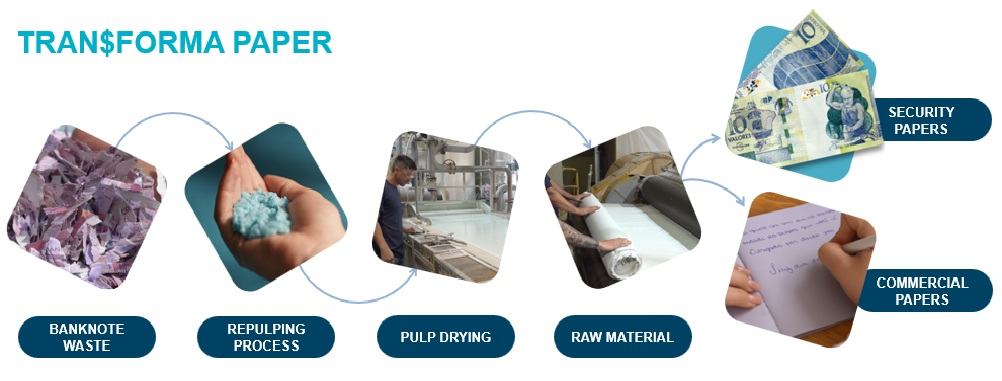
Two years ago, BP Security and Casa da Moeda do Brasil began exploring the recovery of cotton fibres from banknote production waste. The aim was to repurpose these fibres for the manufacture of new paper products, thus giving them a second life.
The recovered fibres were initially used to produce coloured paper, but has since been expanded to produce a security-grade paper incorporating features such as a watermark and embedded windowed thread.
The process involves a high-oxidation chemical treatment that breaks down the original paper, destroying all inks and embedded security features such as threads and coloured fibres. Afterward, the resulting pulp is passed through a cleaning system to remove plastics and other contaminants, depending on the final application.
Once cleaned, the fibres can be stored at 5% consistency or sent to a dewatering system for water removal, making them suitable for physical transport to the paper machines. These recycled fibres are compatible with various types of papermaking equipment.
By upcycling destroyed banknotes into new high-performance security papers using the developed EcoBreath® technology, Tran$forma reduces the need for virgin cotton and can achieve up to 92% reduction in CO₂ emissions without compromising quality or security standards. To date, the project has processed more than 760 tons of banknote waste.
Read more ▼
ID AWARDS
Best New Series
The Dominican Republic was awarded Best New Series for its National Digital ID and ePassport programme, recognising a coordinated, end-to-end modernisation of citizen credentials: the Electronic Cédula de Identidad (electronic identity card) issued by the Junta Central Electoral (JCE) and the country’s new ePassport, issued by the country’s Dirección General de Pasaportes (DGP).
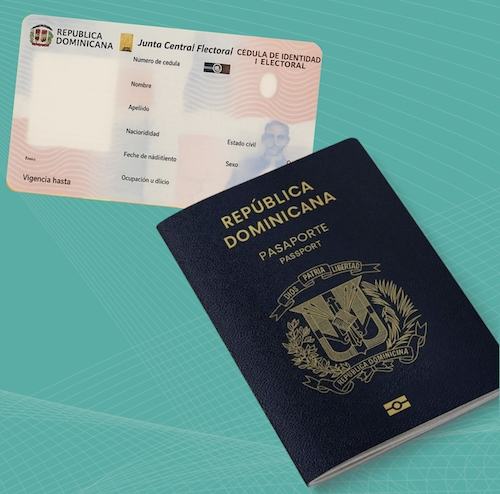
The award acknowledges a single security and interoperability architecture spanning both credentials, replacing legacy documents with a durable platform designed for long validity, high tamper resistance and controlled future expansion.
The Electronic Cédula is built on a polycarbonate body with laser personalisation and runs a Java Card operating system, enabling multi-application use, robust key and certificate management, and governed lifecycle control, including regulated updates where permitted. This produces an eID engineered for sustained resilience as attack techniques evolve.
For first-line inspection, the Cédula integrates Multiple Laser Image (MLI) effects, tactile relief, microtext, UV-reactive inks and optically variable devices (including a KINEGRAM feature by OVD Kinegram), complemented by a secondary portrait in a transparent window. An ICAO-compliant contactless chip protects biometric data using PACE, EAC and Active Authentication, raising the technical and economic barriers to cloning and manipulation.
The series also includes the new ePassport with a polycarbonate datapage, overt and covert security printing (UV elements, microtext and precision see-through effects), and electronic protection via Thales’ chip to support fast, reliable biometric authentication.
Programme controls include multi-biometric enrolment, PKI-backed integrity, traceability, and secure issuance and logistics.
Read more ▼
Best New Passport
Argentina has won the award for the Best New Passport, recognising the country’s new-generation travel document issued under the RENAPER (Registro Nacional de las Personas) modernisation programme. The redesign was announced in January 2026 as part of a wider update to Argentina’s passport and national ID security.
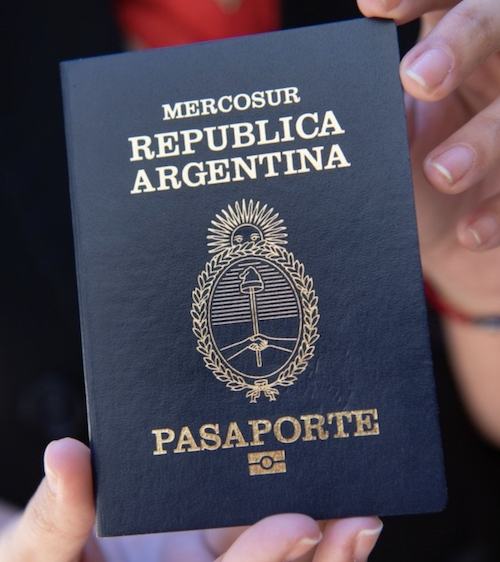
A key engineering change is the introduction of polycarbonate as the datapage substrate, bringing the passport in line with contemporary international practice for high assurance ePassports.
The datapage integrates optically variable features, adding overt checks that are difficult to reproduce with conventional print-counterfeit attacks. Machine readability remains fully standardised, with the MRZ maintained in the two-line, 44-character format expected for global interoperability with border inspection systems.
Portrait protection is implemented through multiple images: the holder’s portrait is presented together with a ghost image positioned to the right, alongside a multiple laser image and the transparent window, providing layered resistance to photo substitution and data manipulation.
Read more ▼
Best New Digital ID Programme
Costa Rica’s Supreme Electoral Tribunal (Tribunal Supremo de Elecciones, TSE) has been recognised with the Best New Digital ID Programme award for the delivery of the Identidad Digital Costarricense (IDC) as a core component of the country’s National Digital Transformation Strategy.
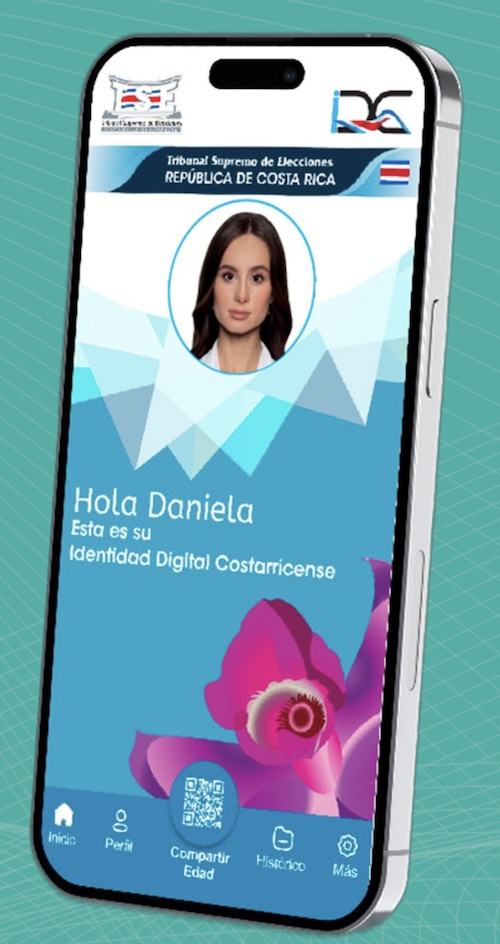
The IDC is claimed to be Latin America’s first fully operational national mobile digital identity with legal equivalence to the physical card, engineered around ISO/IEC 18013-5 mobile credential standards, strong cryptography and biometric features. The IDC programme implements 100% remote issuance, enabling citizens to obtain a government-backed digital credential directly through a mobile-led process using facial biometrics for identity proofing.
A dedicated verifier layer, Verificador IDC, supports privacy-by-design validation. Organisations can authenticate the credential in real time while receiving only the minimum data required for the transaction, reducing the incentive and opportunity to retain or over-collect personal data. The programme extends verifier accessibility across major platforms, including Android and iOS, to support both mobile and desktop environments.
Operationally, the IDC is intended to reduce dependence on physical presence for routine procedures, replacing fragmented account logins with ‘biometric plus PIN’ access and enabling interoperability across public and private services via a standardised identity layer. The architecture is described as sovereign by design, with issuance and verification governance retained under the TSE.
Early integration is underway across banks, telecoms and public institutions, with mandatory acceptance scheduled from 2027 to normalise digital identity use across service channels.
Read more ▼
Best New Process or Technology
The ID Document Awards panel recognised IN Groupe’s LASINK™ Origin+ as the Best New Technology, citing its contribution to strengthening portrait security in modern travel documents through embedded, laser-enabled colour personalisation.
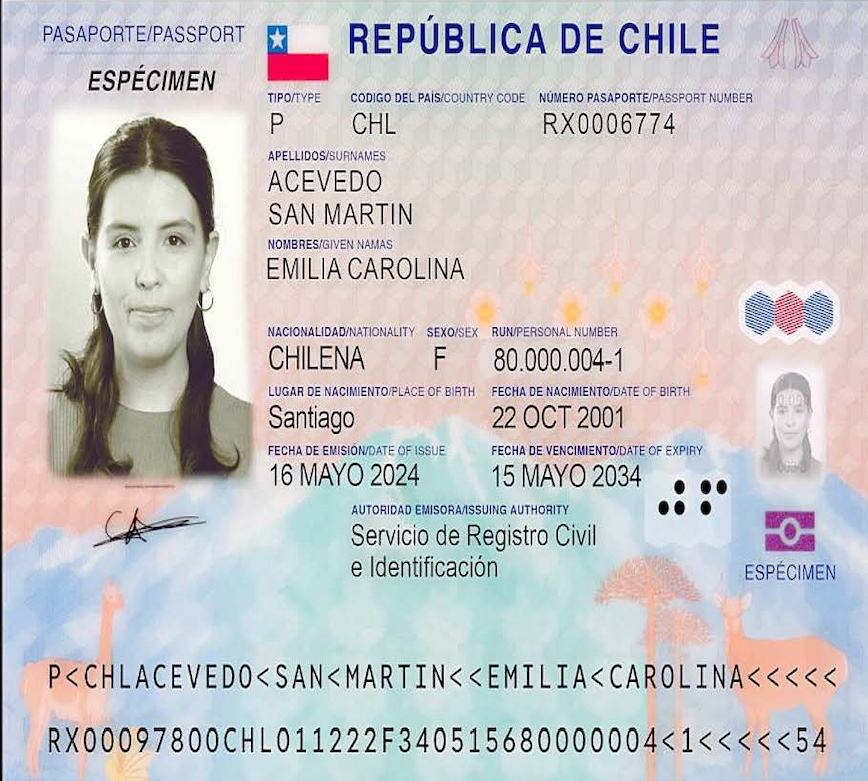
LASINK™ Origin+ extends previous LASINK versions, providing an upgraded implementation that enhances the inspection value of the personalised portrait while retaining the core advantages that made the LASINK family deployable at scale.
A clear example of LASINK™ Origin+ is seen in the datapage of the Chilean passport, integrating the primary holder portrait within the personalisation area, alongside a secondary portrait, biographical data, and the MRZ, illustrating how portrait personalisation is integrated into a layered security design rather than treated as a standalone print element.
This kind of integration is central to the LASINK approach: protecting the portrait in a way that supports rapid human checking while making alteration and substitution ever more difficult.
LASINK™ Origin+ builds on that foundation by advancing the LASINK platform’s embedded colour personalisation capabilities to better support first-line inspection and higher-assurance examination. The result is a security feature that protects the area of the document that is most targeted, the portrait, while remaining practical for issuing authorities that must balance fraud resistance with consistent production throughput.
Read more ▼
Best New Process or Technology
The Aruban Immigration Authority has been awarded Best New Process for the implementation of an upgraded identity document authentication process supporting border management in Aruba. The project was delivered in collaboration with RADEX BCMS (border control management software) and Regula, integrating high-speed, high-assurance document verification into Aruba’s arrival workflow.
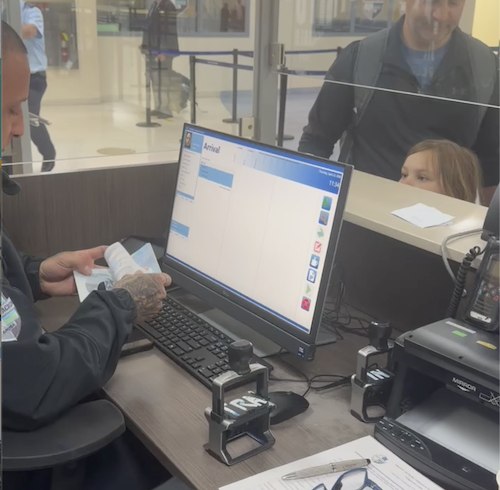
The award recognises a process engineered to solve two competing border-control requirements: stronger fraud detection and faster passenger throughput without reducing inspection quality. Aruba’s introduction of a mandatory online Embarkation and Disembarkation Card system enabled pre-screening before arrival, but its operational value depends on rapid, reliable document verification at the point of entry.
To meet this requirement, RADEX BCMS selected the Regula 7034M full-page document reader for frontline use. The reader performs instant capture and automated checks of key security features under white, infrared and ultraviolet illumination, supported by advanced OCR, barcode and MRZ decoding, as well as RFID chip verification.
Operational results were reported as transformative. Border processing times improved by up to 300%, with the complete control sequence – identification, verification, and authentication of security features – averaging approximately 8 seconds per traveller.
Read more ▼
Best New House ID Card
Authentix won the award for its House ID Card featuring PICO secure™, recognising the integration of a nano-optic, plasmonic optical variable device (OVD) engineered specifically for identity documents. The award acknowledges a design approach focused on Level 1 public authentication, combining high-contrast structural colour with pronounced movement cues intended to be immediately interpretable by non-expert inspectors.
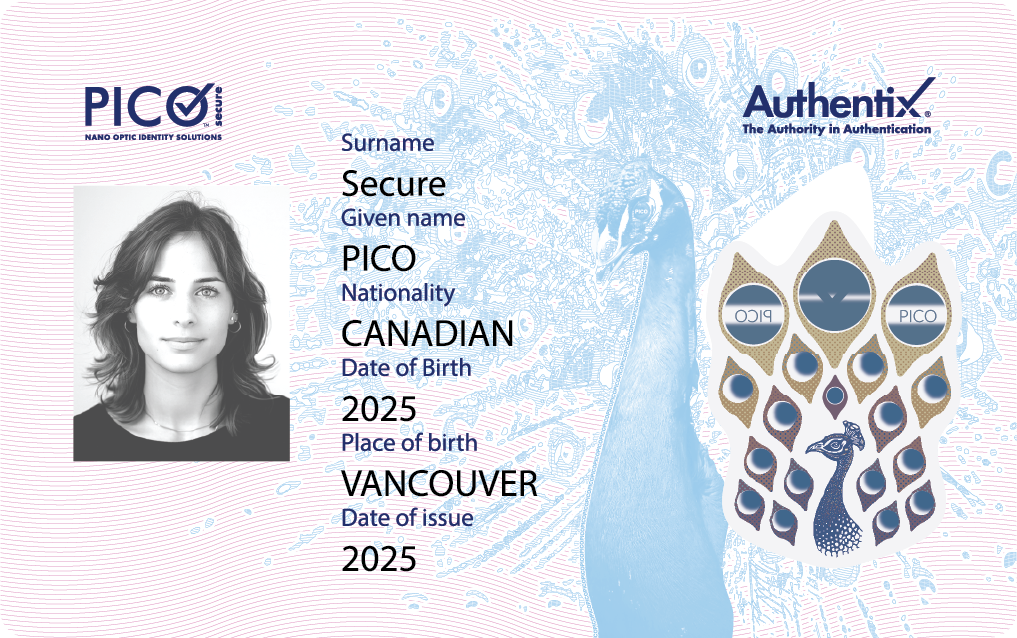
PICO secure™ is based on nanostructured surfaces that generate always-on structural colour without inks or dyes, maintaining visibility across a wide range of illumination and viewing angles. This supports rapid, front-line checks built around simple, document-specific inspection steps rather than specialist tools.
A key technical attribute recognised in the House ID Card implementation is integration flexibility. Authentix’s encapsulated nano-optic structures are designed to be applied to paper and composite substrates or embedded into polycarbonate without requiring new or modified production equipment. Despite minimal thickness, the construction is engineered to tolerate converting steps relevant to ID cards, including overprinting and lamination, while maintaining optical performance.
For polycarbonate card bodies, the feature offers dual-sided visibility, enabling the same nano-optic image to be viewed from both front and reverse. This allows designers to link graphics with the card’s storytelling while retaining a strong overt authentication effect at the surface.
Read more ▼